Showing posts with label Art of the Holocaust by Janet Blatter and Sybil Milton. Show all posts

Thursday, 8 March 2012

Interpreting Art: Analysis 2

"Mass Deportation."
Hendrik Valk
Watercolour and China Ink


This image shows a mass of people that were deported during the Holocaust. This is a depiction of just one section of one deportation. Instantly the reality of the statistics - 6 million - hits home and becomes hard to take in. 


You can see the mechanical way in which these people are drawn - almost like lego. The structure of this particular story is clear, straight from the first glance.


I believe this image shows us how the millions of people who were persecuted during the Holocaust were treated in the same manner and were looked upon with the same prejudice. None of them were treated as individual human beings.


The very linear and structured composition that Valk uses also enhances and warns of the methodical torture and mass extermination that awaited these people when they were to arrive at there destination. 


This image, to me, conveys a certain irony about it all. How can an image of this theme be so structured and linear when the whole idea of the Holocaust was as immoral and illogical - as far from perfect as you can get? 


The SS Guard, larger than life, dominant and threatening - the "Master" holding a gun and what appears to be a knife of some kind. 
The Persecuted, innocent and weary, walking like beggars, crippled from the weight of their belongings.


I feel that I had to abandon this analysis after this last comment. This is because I think I am getting to carried away with my own opinion. However, I think it acts as a good piece of research because after looking up various critical texts that talk about Holocaust Art, I have found that it is almost impossible to find one that is neutral - in the sense that the authors opinion doesn't take over. Perhaps, I what I have learnt from this project the most, is that you can't be unbiased when talking about this theme? I feel that the whole subject matter infuses a great deal of anger and upset in the analyser. I have also found that you can get very lost in this kind of artwork. The Holocaust is such an intense subject and one that effects so many people, that it's hard to not go over board sometimes. 

Interpreting Art: Analysis 1

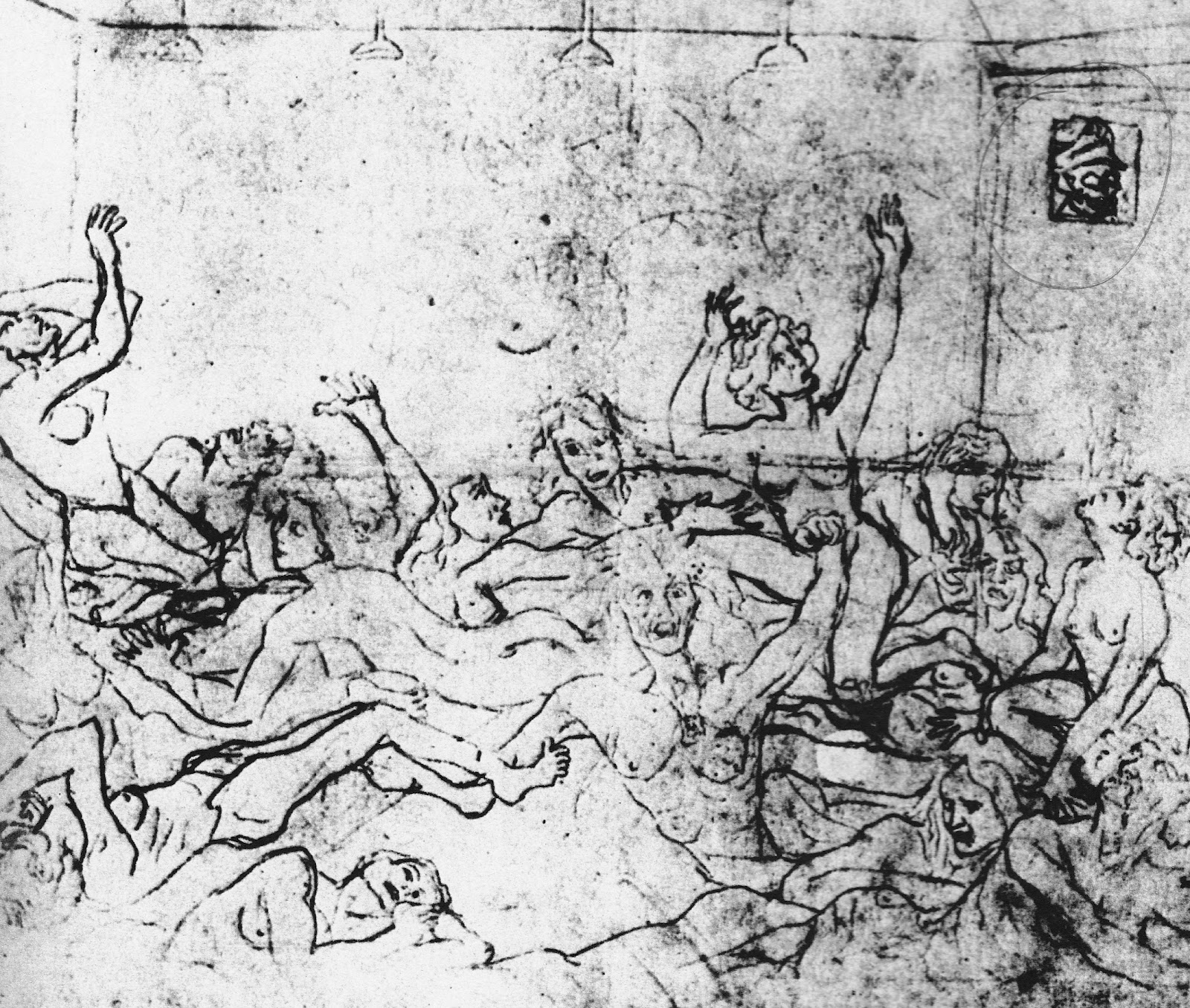
"In the Gas Chambers."
Wiktor Siminski
Pencil
(Sachsenhausen, 1944)


When I first looked at this image, I was shocked and disgusted.
The subject of this pencil drawing by Siminski, which was created at Sachsenhausen Extermination Camp in 1944, documents mass extermination of female prisoners by the Nazi's, through the horrific method of gassing


 The subject matter is revolting and inhumane. I am left in despair at the helplessness depicted in these suffocating individuals but also by the fact that Siminski, like so many others, were subjected to this kind of visual torture every day in Camp life. 


I think that these feelings must come from the way in which Siminski has created this image. The construction of the artwork brings you inside the Gas Chamber. On the ceiling, you can see the old trick - shower hoses - used by the Nazi's to deceive and "reassure" the prisoners that they were going to come out alive. The viewer is alongside these women as they twist into helpless poses, almost reaching for any kind of help, for a breath of clean air, for hope that this torture will soon end as the gas is unleashed. 

The way in which Wiktor Siminski has drawn these women, to me, resembles the beautifully elegant, curvaceous Renaissance studies we see from the likes of Botticelli and Da Vinci. Perhaps this is why the female figures exude such innocence? I feel that despite the fact that the Nazi's aim was to dehumanise these people, this image shows the females as human beings and with feelings. And also, that haunting and questioning expression..."Why?".  


After analysing this pencil drawing some more, I spot the SS Guard leering in through the window. Watching, with a haunting smile as he carries out this atrocity. But then, I see that his face is actually a skull. Like Death watching over as he claims more victims. And also, like the skull that made up the SS Insignia. A true image of terror - an image that brings home the reality and the cruelty of the Holocaust and the Nazi Regime. 


I am reminded, as I look through this image, yet again, of Vladimir Propp's theory. Clearly, the Villain is shown and so are the Desperate in need of help. Unfortunately, the Hero is missing. 

Further thoughts.

After rereading the last post, a lot of different points have occurred to me. These are all things that I would like to cover all be it briefly, in this project. 
  1. How we interpret art.
  2. What stories do we see?
  3. Why do we see them that way?
  4. What is the difference between subtle and graphic art? - I.e, Do we need to be bombarded with graphic images to be able to understand what is happening? Does just a subtle suggestion that lingers on our mind for maybe weeks provoke just the same amount of feeling and thinking about an artwork as it does when we are shown an artwork which is graphic and self-explainatory?
  5. Does it make a difference knowing the history behind an image? I.e, does it effect our opinion of it? does is effect our experience of the image? 
After my tutorial.

After my tutorial, it became clear that I need to start looking at the language of the art that I have chosen to research. I need to start analysing the images and look at how they relate to the points above. I am still really interested in the way that people document and tell stories through their art, but as this research project has developed, I have become more aware of the different aspects that are involved in making an artwork tell a story.


The Experiment.


Also, after the question of whether knowing the story behind an image effects the way in which we interpret it that came up in my last post, I decided to experiment and ask someone to look at it who did not know the story and had never seen the image of "The Liquidation of Dr. Korczak's Orphanage" by Halina Olomucki before.


I hid all of the writing surrounding the image and the title of the piece from the person. I then asked them to tell me what they thought of the image. They said that it looked very chaotic, a group of people lining up and walking. Then I told them what the story was behind the image and it completely changed their outlook on the whole image. They used words such as, 'horrible', 'horrific', 'sad', 'heroic' and 'thought-provoking'.


Interesting Fact.


After some more online research, I actually found this website:


http://lastexpression.northwestern.edu/


which I briefly looked through. I found that the art created by the prisoners in the ghettos and Concentration and Extermination Camps was actually used in the Nuremberg Trials as evidence of war crimes and crimes against humanity. They were used to prove the existence of the gas chambers, crematoria and the way the Nazi and SS Guards treated the prisoners.
So basically, this sums up my question that I started with. These images were not only tell the stories of the lives of the people who were persecuted during the Holocaust, but they actually were also used a documentation and evidence to help bring the persecutors to justice.

Wednesday, 29 February 2012

Research.


(http://www.klinebooks.com/kline/images/items/25279c.jpg)

I was walking through college about a week before Holocaust Memorial Day, which is on the 27th January every year (it marks the liberation of Auschwitz-Birkenau concentration camp), and I spotted some images of the Holocaust. As I walked through the corridor and looked in the display cases which were filled with photocopying's of newspaper cuttings about the Holocaust and various survivors, photocopies of perpetrators and also images of the victims inside the concentration camps. This book, 

Art of the Holocaust
by Janet Blatter and Sybil Milton

was in one of the cabinets. After asking to borrow it for this project a few weeks later, I looked through and it's basically the most extensive collection of sketches by Survivors, POW's, various Camp inmates, people who were in hiding etc. that I have seen while I have been researching this project. I took some photocopies of many of the images in this book because they really had an effect on me. 

Each individual picture is different yet they all seem to be telling the same story, the same suffering, the same hunger and sadness and the same desperation to be freed from the Nazi grip. 

While I was looking through the book, I came across this image:


"The Liquidation of Dr. Korczak's Orphanage."
Halina Olomuck.
Pencil on yellowed paper
(Warsaw, 1941 - 43.)


This image, tells the true story of Dr. Janusz Korczak, a Polish Jew, who ran the orphanage in the Warsaw Ghetto. When the ghetto was liquidated, he was given the option to stay behind and work in the hospitals but he refused and followed his orphans into the Gas Chambers at Treblinka Death Camp.

So, here is where the answer to my argument really begins. This image is telling the story of these orphans who were sent to their death. But it is also documenting the heroic act of Dr... who refused to let the children die alone. 

However, I was already aware of this story. After my visit to Auschwitz in 2010, I got involved in the preparations for Plymouth's Holocaust Memorial Day on January 27th 2011. During this time, I met a man who works with the Plymouth Muti-Faith and Cultural Diversity Centre who told me the story of this Dr...

So this leads to another question...Does knowing the story behind an images like this one, make the experience of it any stronger? 
Does the fact that this document (the image of this event) is explained more clearly and therefore we can understand it more?

My point is that the story was very moving when I first heard it, maybe it was reinforced by my visit and own experience of Auschwitz during which I stood in the place where this man and the said children were murdered. But would someone who didn't know this story before hand react differently to the image once they were told?

Maybe this is something that I need to experiment?